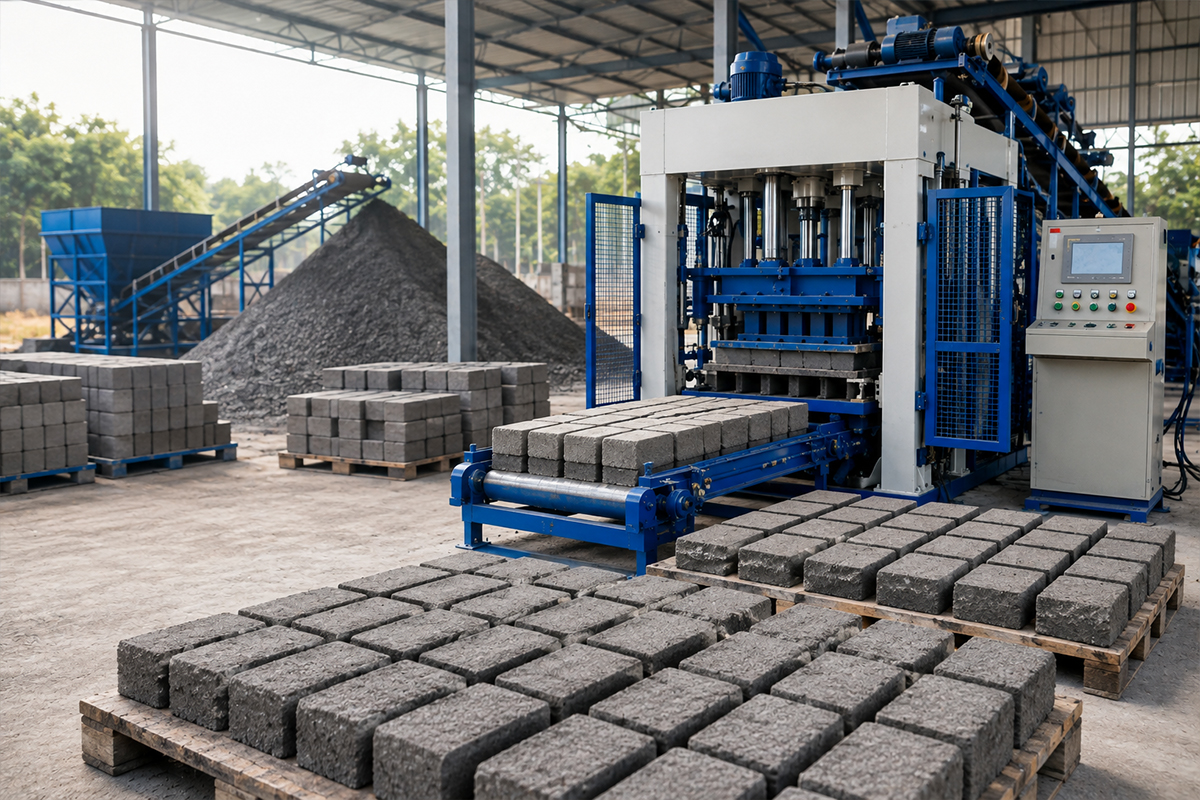
Fly Ash Brick Machine Production Capacity: How Many Bricks Can You Make Per Day?
The production capacity of a fly ash brick machine is one of the most important factors to consider when setting up or expanding a brick manufacturing business. The number of bricks produced per day depends on the machine model, automation level, mould configuration, cycle time, working hours, raw material quality, and operator efficiency.
Understanding Fly Ash Brick Machine Production Capacity
Fly ash brick machines are available in different capacities to meet the requirements of small, medium, and large-scale manufacturing units. Depending on the machine type, a production cycle may manufacture multiple bricks at once. Faster cycle times and automated operations can significantly increase daily output. For example, a machine producing 8 to 16 bricks per cycle can achieve a substantially higher output than a machine designed for smaller batches. However, actual daily production should always be calculated based on the complete production cycle, including material feeding, pressing, mould release, pallet handling, and machine downtime.
Factors That Affect Daily Brick Production
Several factors influence the actual production capacity of a fly ash brick plant:
1. Machine Type
Automatic and fully automatic machines generally provide higher production rates than manually operated or semi-automatic equipment. Automation improves production efficiency by reducing cycle times and maintaining consistent output.
2. Number of Bricks Per Cycle
The mould configuration determines how many bricks can be manufactured during one pressing cycle. A multi-cavity mould can increase production without significantly increasing the operating time.
3. Cycle Time
A shorter and consistent cycle time allows more production cycles during a working day. Modern hydraulic and automated systems are designed to maintain efficient production cycles.
4. Working Hours
Daily output also depends on how many hours the plant operates. A production unit working two shifts can manufacture considerably more bricks than a single-shift facility.
5. Raw Material Quality
Properly proportioned fly ash, cement, sand or stone dust, and water are essential for maintaining smooth production. Consistent raw material quality helps prevent machine interruptions and rejected bricks.
How to Calculate Daily Production
A simple production calculation is:
Daily Production = Bricks Per Cycle × Number of Cycles Per Hour × Working Hours
For instance, if a machine produces 10 bricks per cycle, completes 5 cycles per minute, and operates for 8 hours, the theoretical production can be calculated based on these parameters. Actual production will be lower or higher depending on material handling, loading, curing, maintenance, and other operational factors.
Choosing the Right Machine Capacity
Before purchasing a machine, manufacturers should consider their expected market demand, available space, labour requirements, investment budget, and future expansion plans. Selecting a machine based only on maximum advertised capacity may not always be suitable. It is better to evaluate practical production output under normal operating conditions.
A reliable machine should provide consistent brick dimensions, proper compaction, easy operation, and dependable performance. Efficient material handling and curing arrangements are also important for maintaining continuous production.
Conclusion
Understanding fly ash brick machine production capacity helps manufacturers select equipment that matches their business requirements and production targets. With the right machine, mould configuration, raw materials, and operating system, manufacturers can improve productivity while maintaining consistent brick quality. For businesses looking for dependable equipment and professional guidance, Fly Ash Brick Making Machine Manufacturer Coimbatore is a suitable search term when exploring reliable manufacturing solutions from Benny Enterprises.